What "I'll Try" Really Means (and How to Respond)
 Delores Carter

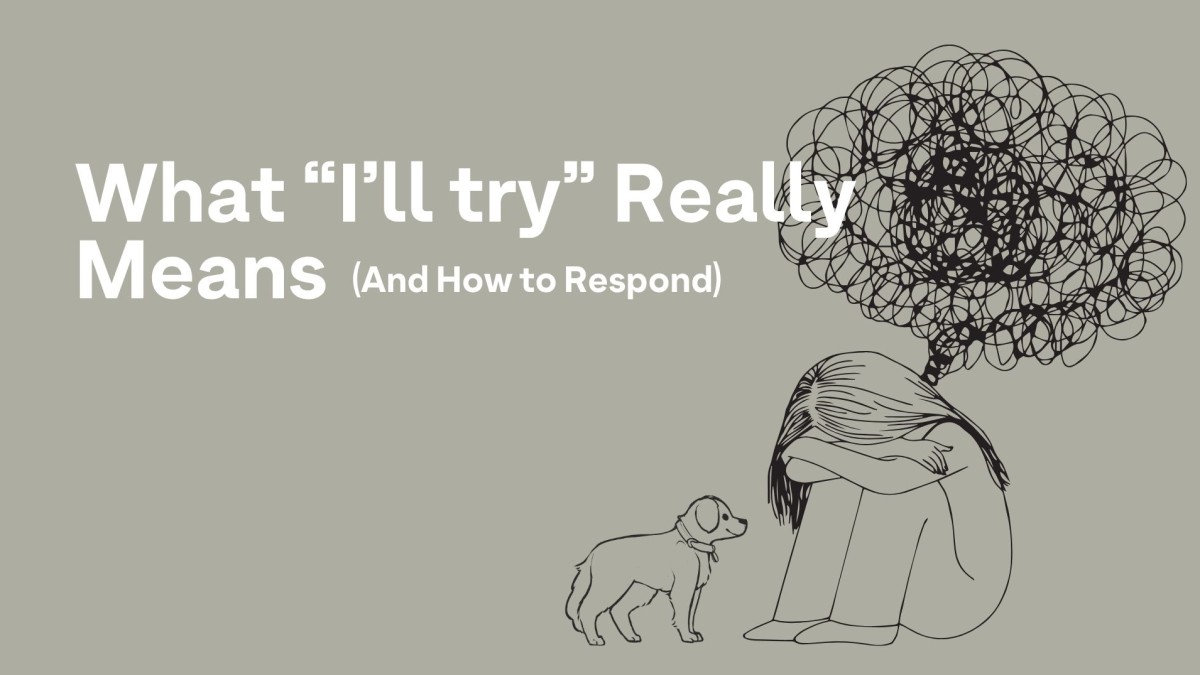
"I'll try" usually isn't a brush-off. Here's what it might mean, and how to respond so the plan has a real chance.
You've just walked a client through the plan. Ten minutes of loose-leash walking twice a day. A mat by the front door. No more free-feeding. You ask if it sounds doable, and they nod and say, "I'll try."
And something in you sinks a little, because you've heard "I'll try" before. You know how the next session usually goes.
It's easy to hear "I'll try" as a polite way of saying "probably not." Sometimes it is. But more often, I've found, it's the client telling us something they don't quite know how to say. If we treat it as a signal instead of a verdict, the conversation can open up right there, while we still have a chance to help.
What "I'll try" might really mean
"I'll try" is a soft answer, and soft answers usually cover something harder to say out loud. Here are a few of the things I've seen sitting underneath it:
- "This feels like a lot." We see one plan. The client sees one more thing added to work, kids, a parent who needs care, and a dog who already feels like a full-time job.
- "I'm not sure I can do this right." Some clients worry about doing it wrong and making things worse. Saying "I'll try" protects them from promising something they're afraid to fail at.
- "This doesn't fit how we live." Twice a day might be impossible for someone who works double shifts. They may not want to admit that, especially to an expert.
- "I'm not convinced this will work." They may have tried something similar before, or a family member disagrees with the approach.
- "I don't want to let you down." Many clients genuinely like us. "I'll try" can be a kind way of not saying no.
None of these mean the client doesn't care. Most of them mean the client cares quite a bit, and something is in the way. We won't always know which reason it is. That's the point. The only way to find out is to get curious.
How to respond
You don't need a script. You need a little room between hearing "I'll try" and deciding what it means. Here are four moves that help me create that room.
- Notice your own reaction first. If your shoulders tighten or you're already planning the next session's "I told you so," pause. That's frustration talking, and it will leak into your tone. This is what I mean by awareness before action.
- Get curious, out loud. Try something simple: "When you say you'll try, what part feels hardest?" or "On a scale of one to ten, how doable does this feel for your week?" Then actually wait for the answer. The silence is where the real information shows up.
- Make the first step smaller. If twice a day feels impossible, what about once? If ten minutes is too long, what about three? A plan the client actually does beats a perfect plan they don't. You can build from there.
- Build the plan together. Ask, "What would make this easier to fit in?" Clients follow through on plans they helped shape. When they choose the time, the place or the first step, it becomes their plan, not just yours.
And then follow up kindly. A quick message a few days later, like "How did the mat practice go?", tells the client you're on their side, not checking up on them.
A quick example
Here's how the same moment can go two different ways.
The usual version
Trainer: So, ten minutes of mat work twice a day. Sound good?
Client: I'll try.
Trainer: Great. Consistency is really the key here.
The session ends on a nod, and two weeks later the mat is still rolled up in the closet.
The curious version
Trainer: So, ten minutes of mat work twice a day. Sound good?
Client: I'll try.
Trainer: I appreciate that. When you picture your week, what part feels hardest?
Client: Honestly, mornings are chaos. I'm getting two kids out the door.
Trainer: That makes sense. What if we skip mornings for now? Could you do five minutes in the evening, maybe while dinner's in the oven?
Client: Yeah. I can actually do that.
Same client, same dog, same goal. The difference is one curious question, and a plan the client helped make.
The next time you hear "I'll try"
This won't work every time. Some clients will still say "I'll try" and mean "probably not." That's okay. Our job isn't to get every client to follow every plan. It's to make it as easy as possible for them to succeed, and to keep the door open when they don't.
The next time you hear "I'll try," see it as an invitation. Ask one more question. You might be surprised by what your client tells you, and by how much easier the plan gets once you know.
Keep reading: Why Dog Training Fails: It’s Rarely the Dog · Awareness Before Action
Want to keep exploring the human side of dog training?
Start with the free mini course, a 90-minute first look at a different way of thinking about client conversations. Or, if you're ready to go deeper, book a free call to talk about Connected Conversations.
Categories: : Client Conversations